



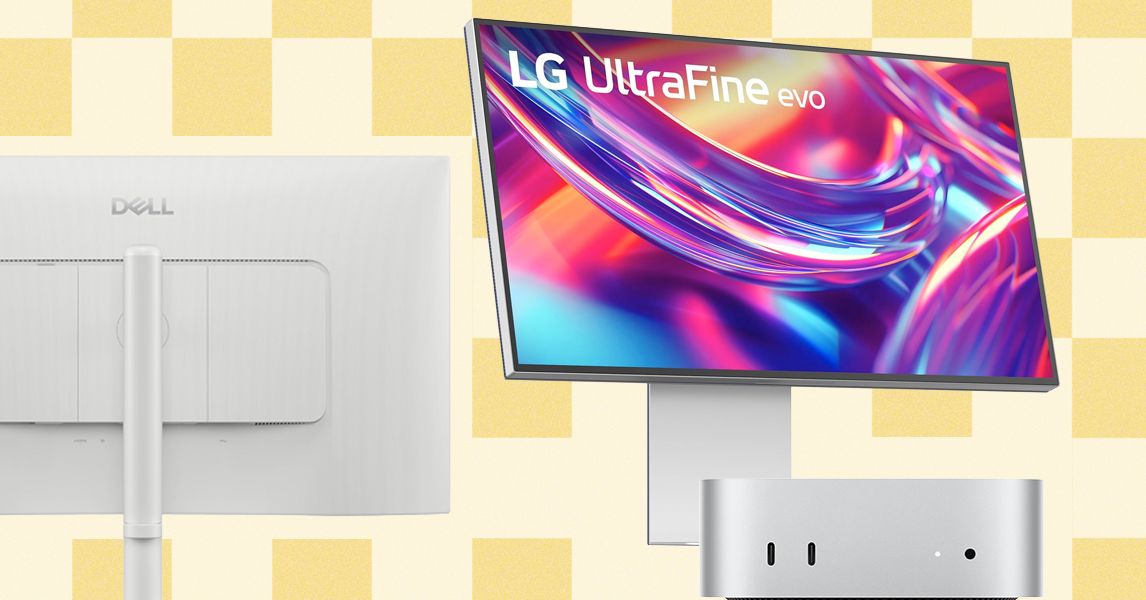
Almost any monitor can work with a Mac Mini. It does not need to be manufactured by Apple or have any official certification. There are reasons to use a cheap 1080p monitor with the Mac Mini, but most Mac users will want something a little more premium. As you can see from options like the Dell 27 Plus 4K, that doesn’t have to mean too expensive. Either way, these are the four elements to consider when purchasing a good monitor for your Mac Mini.
Size and resolution: 27- and 32-inch monitors are the most common sizes today, and there are larger options. I would also consider a 34-inch ultrawide monitor if you like the wider 21:9 aspect ratio with a curved shape. With Apple, resolution is king. There’s a reason it invests so much in high pixel density for every display it sells, even down to entry-level options like the MacBook Air. Pixel density is what gives a display its sharpness, and many more pixels are needed when spread across a large external monitor. If you want to keep fidelity high, I wouldn’t buy anything below 4K, and going up to 5K or 6K on a 32-inch monitor can help. You also want to consider the refresh rate here. The MacBook Pro has a 120Hz refresh rate, which offers smoother animations, especially in games.
Adjustability: Apple monitors and iMacs aren’t exactly known for their adjustability. They often don’t have any and cost more when they do. That’s not the best for your posture and ergonomics. The Pro Display XDR famously charges an additional $1,000 to add a Pro Stand with adequate adjustability. For ergonomic reasons, the top of the screen you’re working on should be as close to eye level as possible, and that varies depending on the person’s height. If a monitor cannot be adjusted in height, you will have to rely on a freestanding monitor stand or arm. In addition to height adjustment, many monitors also have a stand that can swivel, tilt, and swivel, all of which is important when using multiple monitors together. This is also necessary if you want to use a second monitor vertically, something that has become increasingly popular.
Ports: Even the cheapest monitors will always have HDMI as a connection, which is all you need to plug it directly into the back of the Mac Mini. Some monitors have USB-C display support, which will allow you to connect to one of the Thunderbolt ports on the Mac Mini. The M4 Mac Mini comes with three Thunderbolt 4 ports, HDMI, and an Ethernet connector. The M4 Pro model has the same ports, except the ports are Thunderbolt 5 instead of 4. You will need to use at least one of these Thunderbolt ports if you want to connect more than one external monitor. These monitors also usually have other ports, such as USB-A. These can be useful, as the Mac Mini doesn’t have them on its own.
Image quality: Apple prides itself on the image quality of its Macs, so in the case of the Mac Mini, you’ll probably want to get something worthy of your Mac. This is especially important for content creators, photographers, and designers. Therefore, you’ll want to consider a monitor’s brightness, color accuracy, color coverage, and contrast. While some IPS displays offer decent color and contrast, mini-LED or OLED displays will ensure better image quality. These also have significantly higher maximum brightness on HDR content, which really brings games and movies to life.
#monitors #Mac #Mini #tested #reviewed