





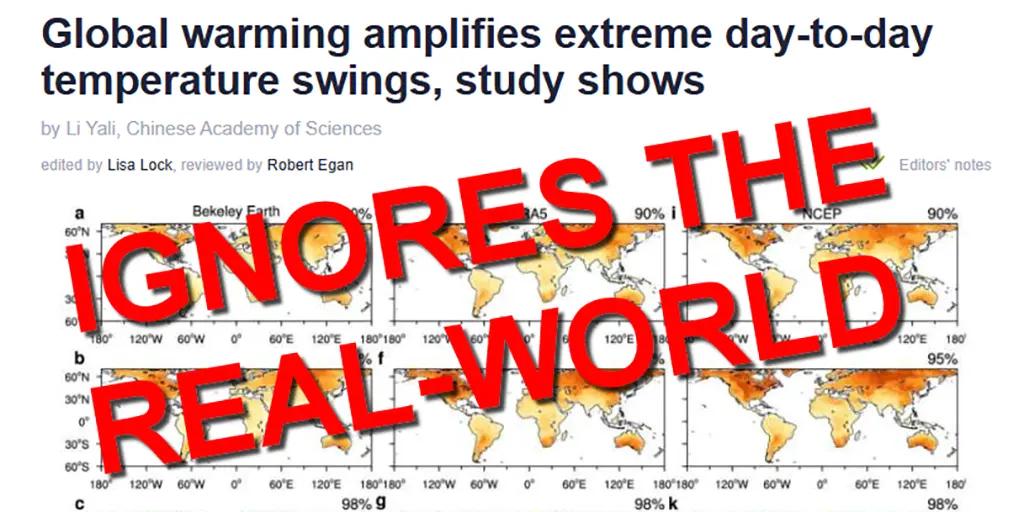

Phys.org recently published “Global warming amplifies extreme daily temperature changes, study finds“ reporting on a new study in Nature Climate Change which claims that human-caused warming is intensifying rapid daily temperature fluctuations, creating a new category of climate hazard in the process. This is false. Not only does the underlying study rely almost entirely on notoriously flawed climate model assumptions, it also surprisingly ignores well-documented real-world factors that directly affect short-term temperature variability, such as the urban heat island (UHI) effect and biases in the location of temperature stations. These omissions fatally undermine the study’s conclusions.
The Phys.org press release states that “extreme daily temperature changes have become more frequent and intense in low- and mid-latitude regions,” and the researchers’ “optimal fingerprinting” methods confirm that greenhouse gases are the primary cause. He further states that this daily volatility creates “a climate roller coaster” that is detrimental to public health. The underlying Nature Climate Change The study echoes this framework and presents global maps of amplified temperature changes, but never addresses the integrity (or contamination) of the surface data used.
This is the central flaw of the study: Urban heat island (UHI) pollution artificially raises minimum night temperatureswhich will cause the next day’s temperatures to start from an already elevated baseline. Artificial surfaces (pavement, buildings, vehicles, heat-retaining infrastructure) release stored heat at night, raising minimum temperatures and exaggerating the apparent magnitude of daily variations. However, the terms “urban heat island” or UHI do not appear even once in it Nature Climate Change publication or press release. The article also does not mention the location of temperature stations, the quality of the metadata, compliance with microsite quality control, or any discussion of observation uncertainty.
These omissions are inexcusable because, as the linked Heartland Institute report points out Corrupt weather stations: Official US temperature record remains fatally flawed shows, About 96% of NOAA weather stations do not meet the National Oceanic and Atmospheric Administration’s (NOAA) own location requirements.and are corrupted by localized heat sources such as asphalt, roofs, HVAC exhaust, machinery, or reflective surfaces. The Heartland report shows that compliant stations (those free of artificial heat pollution) exhibit about half of the warming trend found on corrupt network. See the figure below. Note the difference between the blue line (the non-corrupted stations) and the orange and red lines.

These findings are supported by NOAA’s own location standards and confirm that seasonal bias, not climate physics, drives much of the exaggerated warming in the US record and, by extension, much of the world.
If the observational foundation is distorted, the conclusions derived – such as “increasing day-to-day temperature volatility” – are also distorted.
Furthermore, the Nature Climate Change The authors use global reanalyses and model-based “optimal fingerprinting” to attribute these amplified oscillations to greenhouse gases. But a model based on biased data will simply reinforce or exacerbate those biases. None of the physical mechanisms proposed by the authors (changes in soil moisture, pressure variability, drought feedback) can be meaningfully evaluated if the input data set contains systematic nighttime warming caused by UHI and faulty station placement.
Precisely for this reason US Climate Reference Network (USCRN), which by design avoids artificial heat sources, shows smaller warming trends than older and more contaminated networks in urban areas. See the USCRN figure below showing maximum temperatures in the US since 2005. Note the lack of an increase in extreme temperatures (peaks) today compared to 20 years ago, or any obvious upward trends in the data.

Source: National Centers for Environmental Information (NCEI) here: https://www.ncei.noaa.gov/access/monitoring/national-temperature-index/time-series/anom-tmax/1/0
However, the current study never references USCRN data, nor any equivalent bias-free baseline.
Even their findings on health risks are based on heat-biased data. If nighttime temperatures are artificially raised due to urbanization and poor location, the apparent “roller coaster changes” reflect local changes in land use, not global climate physics. Therefore, any supposed correlation of health with mortality data would be mixing genuine climate effects with measurement artifacts.
In other words, what is missing is the most basic requirement of climate science: Separating the real climate signal from non-climate noise.
UHI, land use change, asphalt expansion, vegetation loss, waste heat emissions, and explosive growth of built environments raise nighttime minima and increase apparent variability. The study treats all variability as atmospheric in origin, ignoring artificial thermal reserves embedded in modern cities.
A rigorous scientific analysis would have:
- UHI contamination was explicitly examined.
- High-quality rural stations separated from urban ones or with committed microsites.
- The modeled projections were compared to the pristine bias-free USCRN observation network.
- I quantified the effect of documented location violations in my 2022 Corrupt Weather Stations study.
Instead, the authors rely on global models and “fingerprinting” techniques that simply assume the data is valid. That assumption is not supported by the evidence, and the report’s conclusions cannot be meaningfully distinguished from biases embedded in the underlying data. This is not “a new extreme climate danger”—is the predictable result of modeling data with errorsand then attributes those errors to greenhouse gases.
Phys.org does a disservice to its readers by not fact-checking the Nature study and examining other possible causes for its conclusions. Instead of a thoughtful scientific examination of the novel claims made in the study it reports, Phys.org readers got a fawning and uncritical summary of the flawed ones. Nature study, which exaggerates daily variability based on the well-documented role of UHI and location defects. That is not curious journalism, that is promotion; It’s really no better than a press release.

Anthony Watts is a senior environment and climate researcher at The Heartland Institute. Watts has been in the weather business both in front of and behind the camera as a television meteorologist since 1978, and currently does daily radio forecasts. He has created weather chart presentation systems for television, specialized weather instrumentation, and has co-authored peer-reviewed articles on climate issues. It operates the world’s most viewed climate website, the award-winning website wattsupwiththat.com.
Find out more from Watts Up With That?
Subscribe to receive the latest posts in your email.
#Wrong #Phys.org #faulty #thermometers #evidence #climate #roller #coaster #Watts #agree