

In a region of space not far from our Solar System, two separate collisions between space rocks have scattered an incredible amount of debris. Dust clouds at both cosmic crash sites, emitting a radiant glow from reflected starlight, have now revealed that an unknown object that was theoretically an exoplanet never actually existed.
A new study published in Science has provided answers to an enduring mystery surrounding Fomalhaut b, long considered an exoplanet candidate due to its brightness. It turns out that this bright object that astronomers discovered in the sky in 2008 was not an exoplanet, but a huge cloud of dust left behind by a collision of space rocks. Now, a second similar collision has researchers intrigued to find out what is happening in this bustling planetary system.
Read more: Two Nova explosions reveal structures never before seen in stellar explosions
A mysterious light in the sky

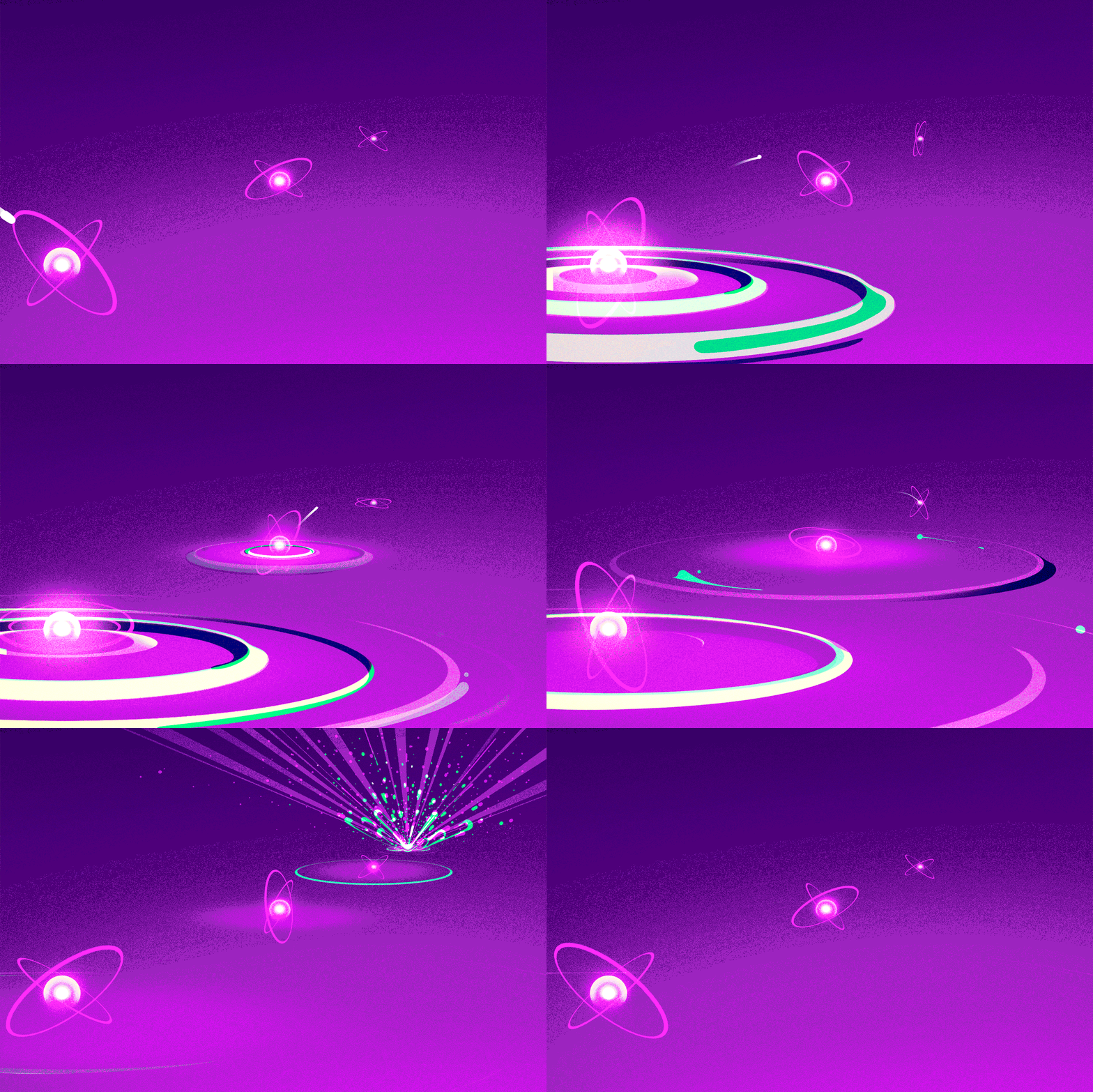
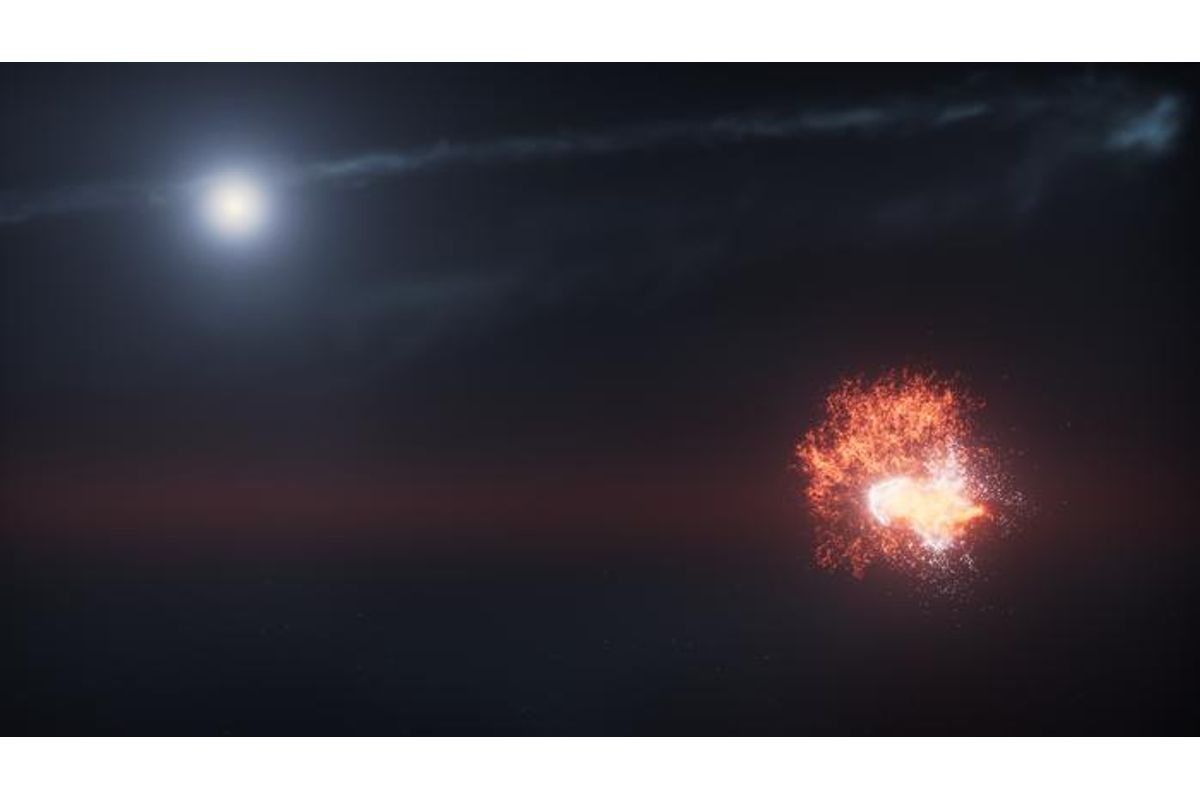
Sequence of a massive collision between two objects that created a cloud of dust near the star Fomalhaut.
(Image credit: NASA, ESA, STScI, Ralf Crawford (STScI))
Astronomers were always unsure about the true identity of the object initially known as Fomalhaut b, named after its nearby host star Fomalhaut.
Researchers attempted to check the light source in 2023, but when they looked at images from NASA’s Hubble Space Telescope, it had mysteriously disappeared. However, they found a separate light shining in a slightly different location, according to a Press release In the new study,
Comparing this view with previous images, the researchers confirmed that the missing object was a dissipating dust cloud, now known as Fomalhaut cs1 instead of Fomalhaut b. This cloud has since faded, as the dust has been pushed into interstellar space by the pressure of starlight radiation.
Researchers are now keeping a close eye on the latest light source, a dust cloud called Fomalhaut cs2. Both cs1 and cs2 probably arose from rare collisions between planetesimals, which are rocky objects like asteroids.
space rock remains
The observations of Fomalhaut cs1 and cs2 mark the first time that planetesimal collisions have been observed outside the Solar System, but as two collisions occur just 20 years apart, the dusty Fomalhaut system may be a prime place to see planetesimals collide with each other.
“The more dust there is in a system, the more planetesimals there will be and the more likely they are to collide. Additionally, if you can concentrate planetesimals in a ring, the more likely they are to collide,” says study author Jason Wang, a professor of physics and astronomy at Northwestern University. “Fomalhaut has one of the most prominent dust belts we know of, and it’s concentrated in a ring, so in some ways it’s the ideal system to find these collisions.”
Researchers hope to see more rare collisions between larger planetesimals in the future, as the dust grains produced could offer new insights into planet formation.
As for what will happen to Fomalhaut cs2, the researchers say it could disperse similarly to cs1, but they haven’t yet ruled out a different outcome.
“It could be that cs2 involved a different type of collision than cs1, and the evolution over time will be different. For example, a different scenario is that a planetesimal impacted a dwarf planet and created a giant dust cloud, except that the dust will remain attached to the dwarf planet and eventually settle back to the surface,” says study author Paul Kalas, an astronomer at the University of California, Berkeley.
Differentiate clouds and planets

Diagram of a Hubble Space Telescope image showing the ring of debris and dust clouds around the star Fomalhaut (marked with a white star). Dust clouds are marked with white dashed circles. The new study reclassifies cs1, previously believed to be a planet, as a debris cloud.
(Image credit: NASA, ESA, Paul Kalas (UC Berkeley))
The revelation that Fomalhaut cs1 was a dust cloud and not an exoplanet demonstrates the possibility of misidentifying light sources in space.
Dust clouds can appear like dust-covered exoplanets under the right conditions, as both are capable of producing similar levels of brightness from reflected starlight. The researchers say that observing this glow at different wavelengths will be a key practice to avoid misidentifications in the future.
Researchers plan to track Fomalhaut cs2 with the James Webb Space Telescope’s near-infrared camera, which can provide color data to uncover details about the cloud’s composition, such as whether it contains water and ice. With this, they hope to learn where the planetesimals were born, how they evolved over time, and what happened in the moments before the chaotic accident.
Read more: Space dust at the bottom of the ocean helps solve the puzzle of 30,000-year-old Arctic ice
Article sources
Our writers at Discovermagazine.com use peer-reviewed studies and high-quality sources for our articles, and our editors review them for scientific accuracy and editorial standards. Please review the sources used below for this article:
#Violent #space #rock #collisions #caused #dusty #accident #nearby #planetary #system