




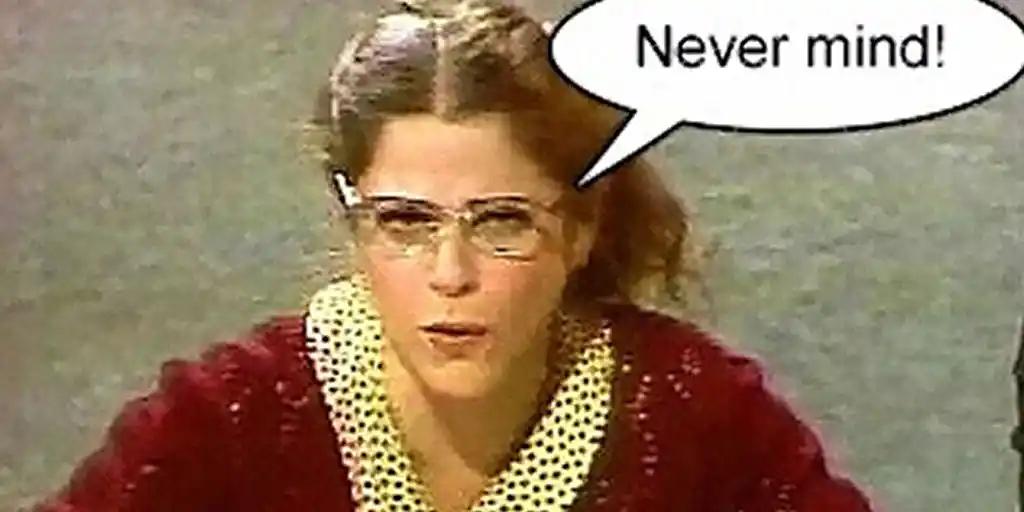
Michael Barone’s “We have arrived at the moment Emily Litella on climate change“ published in Rasmussen Reports, seems like confirmation of something many of us have been documenting for years: the climate catastrophe narrative is collapsing not because of denial or politics, but because it has finally run out of evidence. Barone gives this reckoning a memorable cultural hook, comparing the current retreat from apocalyptic certainty to Emily Litella’s timid “It doesn’t matter”: the moment when a heated argument quietly dissolves under the weight of reality.
What makes Barone’s column especially notable is that it arrives amid a broader fracture in the climate narrative, a fracture I recently described as “The week when climate catastrophism lost its control.“ In just a few days, voices once considered untouchable within polite discourse began to admit what skeptics have long maintained: that claims of imminent collapse were never as strong as advertised.
Barone points out this shift by highlighting figures like Bill Gates and Ted Nordhaus, who now openly acknowledge that climate change is No an existential threat. Gates’ admission that climate change “will not lead to the demise of humanityIt is particularly revealing, not because it is radical, but because it is mundane: an implicit retreat from decades of rhetoric that framed warming as an end to civilization.
That same recalibration was clearly demonstrated when Nordhaus himself wrote: “I no longer believe in this hyperbole.“, repudiating the catastrophic projections he once helped popularize. Barone treats this not as an isolated conversion, but as evidence that the underlying models and assumptions simply failed to produce the promised disasters. From the WUWT’s perspective, this is the predictable result of overconfident modeling, exaggerated feedback, and a refusal to reconcile forecasts with observed data.
What Barone captures particularly well, and what aligns closely with my own op-ed, is how access control has shaped the debate. For years, dissent was caricatured as ignorance, even as emeritus scientists like Richard Lindzen and William Happer were sidelined despite decades of experience in atmospheric physics. When those same scientists explain, calmly and publicly, that climate sensitivity is uncertain and that extreme climate trends remain of little alarming, the spell is broken. The problem for catastrophists is scale: the old filters no longer work.
Barone also highlights the almost religious tone that climate advocacy has taken. Atonement rituals, moral absolutism, and hostility toward heresy have replaced empirical skepticism. At WUWT we have long maintained that once science becomes a belief system, it stops correcting itself. Barone’s comparison of climate activism to secular religion is not hyperbole: it is an observation borne out by how critics are treated and how failed predictions are quietly stored in memory.
Perhaps the most important overlap between Barone’s essay and my own analysis is the emphasis on adaptation and resilience. Nordhaus’s recognition that climate-related mortality has plummeted despite modest warming reinforces a point that catastrophism cannot explain: Human prosperity, technology and infrastructure matter far more than model-based temperature scenarios. As Barone suggests, the public has begun to notice that the promised disasters never quite arrive and that each new “crisis” sounds suspiciously like the last.
In that sense, Emily Litella’s moment is not a sudden revelation; it’s a slow acknowledgment that the emperor has been without clothes for a while. The climate movement didn’t gain certainty: it gained better marketing. Now, as insiders quietly say “it doesn’t matter,” the narrative loses its authority.
Barone’s column is valuable not because it breaks new scientific ground, but because it signals a cultural shift. When traditional commentators begin to admit what skeptical scientists and analysts have argued all along (that the uncertainty is real, that the impacts are exaggerated, and that the catastrophe has been exaggerated), the debate finally moves out of fear and back to the evidence.
If there is a true tipping point here, it is not measured in degrees Celsius. It is measured by how willing people are to question statements that demand obedience but are exaggerated. On that front, Barone’s essay is less a eulogy than a marker: a sign that the long-delayed “never mind” has finally arrived.
Find out more from Watts Up With That?
Subscribe to receive the latest posts in your email.
#Apocalypse #Oops #Emily #Litellas #climactic #moment #arrived #Watts #agree