




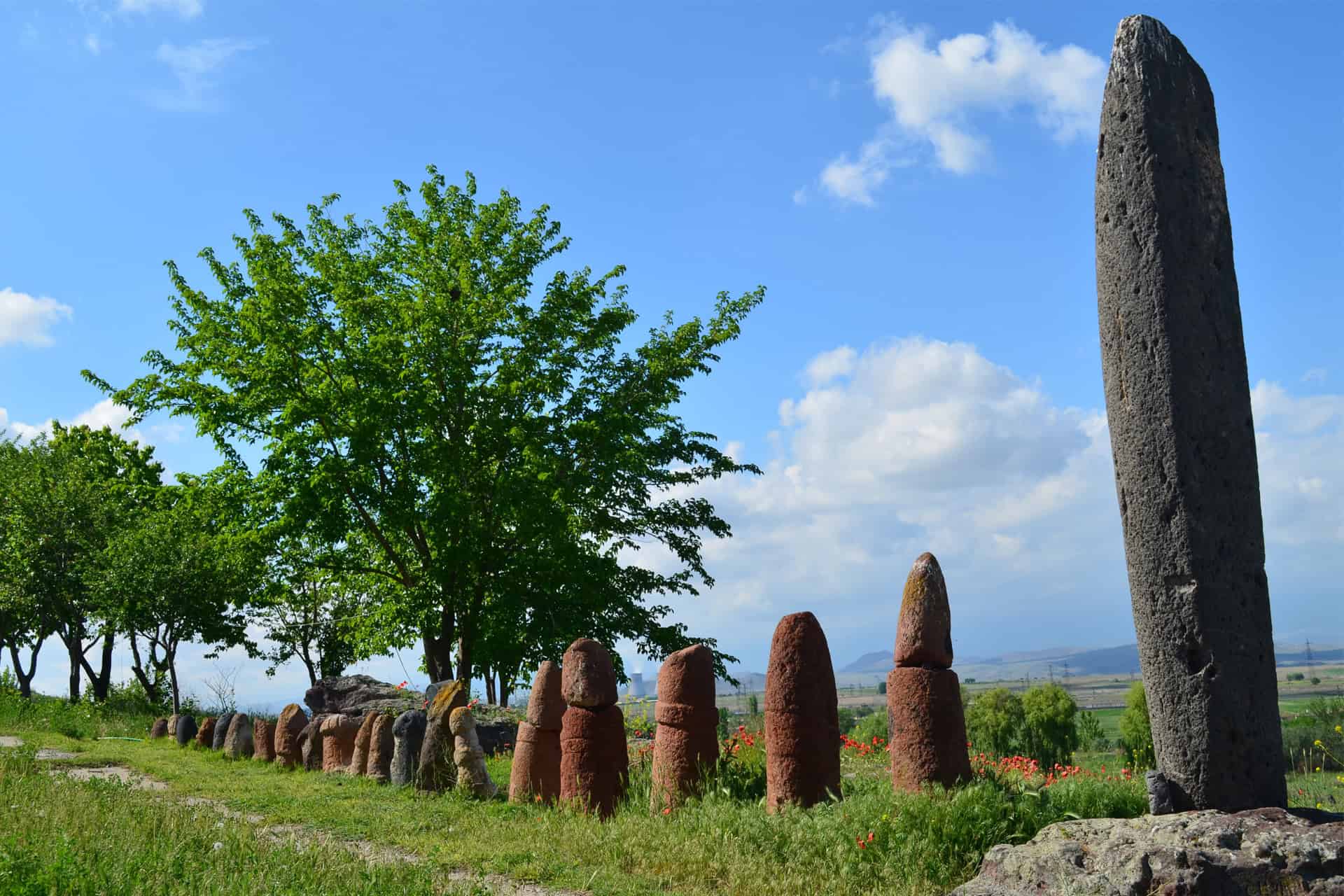
Scattered across Armenia’s highest mountains are giant carved stones that look wildly out of place. Some are taller than a two-story building, but none of these mysterious vishaps or dragon stones are found near known archaeological sites, such as ancient towns.

Archaeologists have struggled to explain why, 6,000 years ago, people dragged these giant monuments into icy, harsh, high-altitude terrain (often above 2,700 meters), where snow limits human activity to just a few summer months. Some argued that they marked territory, while others saw them as purely symbolic or decorative. However, no one could confirm the exact purpose of these silent stones.
A new study now reveals the clearest answer yet. The stones were built for worship, and not as decoration or as markers of territory. But this was not the typical pagan cult.
“The findings support the hypothesis that vishaps were closely associated with an ancient water cult, as they are predominantly found near water sources, including high-altitude springs and discovered prehistoric irrigation systems,” the study authors state. note.
A closer look at the giant monuments
Dragon stones come in three main typologies: fish-shaped stones (pisces), stretched cattle skin shapes (hairs), and hybrid shapes that combine both motifs. Researchers from Yerevan State University and the Institute of Archeology and Ethnography analyzed 115 vishaps in the Armenian Highlands, using a combination of GPS mapping, elevation analysis, precise stone measurements and radiocarbon dating.

This is the first study to do so on this scale. Until now, dragon stones have never been studied in such large quantities. The researchers combined landscape maps, stone measurements and carving details to look for patterns that single-site studies had missed.
One detail immediately caught our attention. Each vishap is polished on all sides except for one narrow end.
“Most vishaps are collapsed or placed horizontally on the ground. However, all three typological groups of vishaps exhibit carving and polishing on all faces, with the ‘tail’ invariably uncarved. This consistent feature strongly suggests that the vishaps were originally placed vertically,” the study authors said.
Another important factor that the research highlighted was location. Vishaps are almost never found far from water. They are found next to springs, meltwater streams, volcanic craters, lakes and prehistoric irrigation canals.

Even their elevations are not random. The stones are grouped in two distinct altitude bands, around 1,900 meters and 2,700 meters above sea level, reflecting different environmental zones and seasonal movements through the mountains. Its form followed function.

For example, fish-shaped stones dominate the highest elevations, near natural springs fed by melted snow. While further down, stones shaped like cow skin appear, where water was diverted for agriculture. This pattern closely resembles how ancient pastoralist communities followed water through the highlands.
“The findings indicate a general correlation between the size of vishaps and altitude, thus challenging assumptions that larger monuments would be concentrated at lower altitudes. Instead, their presence at high elevations suggests important cultural motivations, probably linked to ancient water worship, as vishaps are also predominantly found near springs and are represented by fish forms,” the researchers added.
Work against logic, unless belief demands it

If vishaps were practical markers or casual monuments, archaeologists would expect them to get smaller at higher elevations. In alpine areas, working time is limited to summer days only, and transporting stones weighing several tons uphill is extraordinarily expensive.
But the data shows the opposite.
Large vishaps, some of which weigh more than six tons, are as common at high altitudes as at lower altitudes. Statistical analysis shows no decrease in monument size with increasing elevation, which directly contradicts what would be expected if convenience or efficiency were the primary concerns.
The implication is powerful: people invested an enormous amount of work in the highlands because location mattered. The water sources near the mountain peaks, where the snow is born, had a deep cultural and religious meaning. In 2024, archaeologists discovered Two infant burials under a dragon stone at the Lchashen site near Lake Sevan in Armenia.
As the authors maintain, this sustained effort only makes sense if the stones fulfilled a sacred function, linked to reverence for water as the foundation of life.
The Lasting Link Between Dragon Stones and Water
Radiocarbon dating of the Tirinkatar site places at least some vishaps between 4200 and 4000 BC. C., during the Chalcolithic period, which makes them older than Stonehenge by more than a thousand years.
The study maintains that placing dragon stones in a spring was an act of reverence and protection towards life’s most critical resource.
These monuments were religious symbols, but they also appear to have been related to early irrigation practices and the natural flow of water through the landscape.
Its importance did not fade with time. Later societies reused these sites, carving Urartian cuneiform inscriptions into some stones and, centuries later, adding Christian crosses and religious motifs. Belief systems changed, but the sacred relationship between stone and water remained.

However, many vishaps are now damaged or no longer standing, limiting what archaeologists can reconstruct.
Today, many vishaps are damaged or no longer standing, limiting what archaeologists can reconstruct from the monuments alone. To overcome this, the researchers plan to combine archaeological evidence with climatic and hydrological data to better understand how water availability influenced migration, cooperation and beliefs in early mountain societies.
He study is published in the magazine npj heritage science.


#Ancient #dragon #stones #older #Stonehenge #reveal #lost #water #cult #hidden #high #mountains #Armenia