



What is cell division?
- The life of multicellular organisms begins from a single cell known as a zygote. An adult plant or animal contains millions of cells.
- With the growth of an organism, a large number of cells are formed from pre-existing cells. A single cell divides to form daughter cells, which in turn divide again and again forming a large number of cells.
- Therefore, cell division is a process by which new cells are formed from preexisting cells.
- Cell division in plants is restricted to certain areas or regions called meristematic regions. Animals have active cell division centers in the skin, bone marrow, and certain cells of the intestinal lining.
- In an adult animal, there are fewer or no divisions of nerve cells, and if they are lost, they cannot be replaced.
- To understand the process of cell division it is necessary to study the chromosome structure It is very important because it plays an important role in the process.
- Two main processes are involved in cell division;
- karyokinesis:
- It involves the division of the nucleus or nuclear material (chromosomes). During the division of the nucleus, each chromosome divides longitudinally forming two chromatids.
- These chromatids remain united in the centromere region. The centromere appears as a constriction at one location on a chromosome.
- Spindle fibers attach to the centromere of the chromosome in a dividing cell.
- Cytokinesis: Involves the division of the cytoplasm and cytoplasmic organelles.
- karyokinesis:
- There are two types of cell division:
See also: Differences between mitosis and meiosis
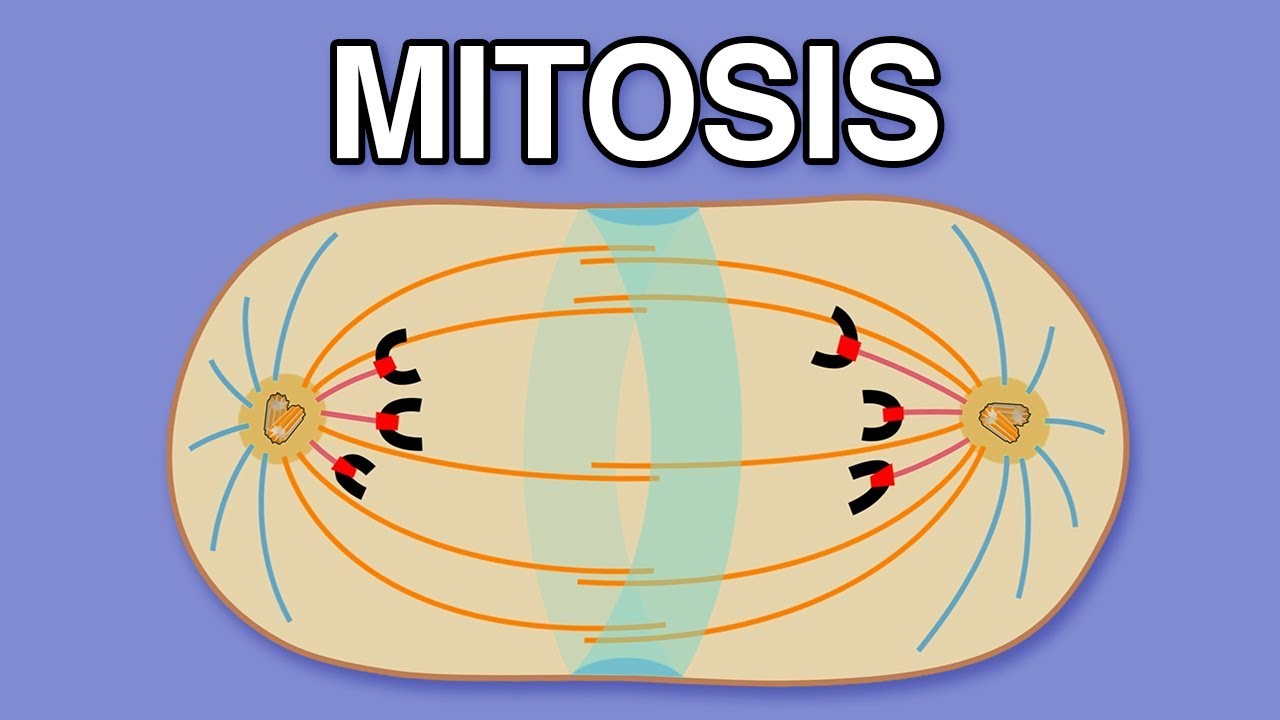
MITOSIS
- Mitosis is a common method of cell division for growth and development or tissue repair in multicellular organisms.
- It occurs in somatic or vegetative cells.
- German biologist Walter Flemming He was the first person to observe mitosis in living organisms in 1877. He called it mitosis, which means thread formation. This refers to nuclear division where chromosomes appear as threads.
- It occurs in all types of living organisms. It is characterized by the division of the mother cell into daughter cells.
- The two daughter cells are qualitatively and quantitatively similar to each other. They contain the same number of chromosomes and a more or less equal number of cellular organelles.
- Therefore, mitosis is also called equational division.
- Once the mitosis process begins, it continues until two new cells are formed. For convenience, the sequence of events that occur during mitosis can be divided into different stages or phases, which are;
- Interface
- Prophase
- metaphase
- Anaphase
- Telophase
- These phases are characterized by the arrangement of chromosomes during nuclear division. that is, karyokinesis.
- Interface:
- Before cell division begins, the cell is in interphase. It is the period between two nuclear divisions.
- It is the non-dividing stage of the cell.
- It is the period of biochemical activities in which DNA replicates and coils around a central protein core to form a distinct chromosome.
- At this stage, the nucleus has a distinct nuclear membrane. You can see the nucleolus, but the chromosomes are long, coiled and thread-like and are called chromatin.
- This is also called the preparatory phase, since the cell prepares to undergo cell division.
- Prophase:
- It is the longest stage of cell division. The core undergoes the following set of changes in this phase.
- The chromatin strands gradually condense into short, thick, coiled condensed chromosomes.
- As the chromosomes become prominent, the nucleolus decreases in size and disappears at the end of prophase.
- The nuclear membrane ruptures and dissolves into the cytoplasm at the end of prophase. This causes the chromosomes to untie and become free in the cytoplasm.
- Just before chromosome activity begins, the centrosome divides into two (now called centioles) and they move away from each other to opposite poles of the cell and form ‘poles’. Each centriole then radiates fibers from the spindle.
- [Note: Centrioles are present in animal cells and some lower plant cells. In most of the higher plants, centrioles are absent and the poles of the divisions are determined by two clear zones in the cytoplasm of the cell.]
- It is the longest stage of cell division. The core undergoes the following set of changes in this phase.

- metaphase:
- Completion of the mitotic spindles (spindle fibers) initiates metaphase. It is much shorter than prophase and consists of the following steps:
- The chromosomes become shorter and thicker and are organized in the equatorial plane of the cell with spindle fibers. This allows for equal distribution of chromosomes in the daughter cells. At that point, it is evident that each chromosome is double and consists of two similar strands called chromatids.
- The chromatids are joined at one point by a centromere. The centromere of each chromosome splits in two, so that each sister chromatid has its own centromere.
- The spindle fibers of the centrioles attach to the centromeres.
- Completion of the mitotic spindles (spindle fibers) initiates metaphase. It is much shorter than prophase and consists of the following steps:
- Anaphase:
- Anaphase begins when each sister chromatid with a centromere separates from each other and moves toward the poles of the cell by contraction of the spindle fibers.
- Contraction of the spindle fibers causes the movement of the chromatids toward opposite poles. These chromatids are now called chromosomes. The new chromosomes adopt characteristic U, V, J shapes depending on the position of the centromeres on the chromosomes.
- The new chromosomes become shorter and thicker.
- The arrival of the chromosomes at the respective poles marks the end of anaphase.
- Telophase:
- It is the final stage of karyokinesis of mitosis. In this phase a core is rebuilt and the following changes occur.
- The chromosomes are found at the poles of the cell and form two groups.
- These chromosomes become longer and thinner through the process of unwinding to form a reticulum or chromatin network and begin to disperse.
- The nucleolus reappears due to the reorganization of nuclear materials that were dispersed during prophase. A new nuclear membrane forms around each network of chromatin and nucleolus. At the end of telophase, two identical nuclei form in the mother cell.
- The spindle fibers disappear. The centriole duplicates and forms a centrosome at each pole.
- It is the final stage of karyokinesis of mitosis. In this phase a core is rebuilt and the following changes occur.
Cytokinesis:
- After the division of nuclear materials (chromosomes), also called karyokinesis, the cell undergoes cytokinesis.
- Cytokinesis is the process of division and separation of cytoplasmic constituents. The cytokinesis process differs in plant and animal cells.
- The end of telophase coincides with the division of the cytoplasm. In animal cells, a constriction appears outside the cell in the equatorial plane. The constriction deepens from the outside towards the center and divides the cytoplasm into two compartments, forming two daughter cells.

- In plant cells, cytokinesis usually begins in early telophase with the formation of a new cell plate at the equatorial spindle. The separation of the cytoplasm begins in the center of the cell and gradually extends outward to each side of the plane, perpendicular to the spindle axis.
- In this way, two new cells are formed, each with the same number of chromosomes as the mother cell. After the process of cell division, the new cells grow in size until they appear to be approximately the same size as the original cell.

Importance of mitosis:
- Tissue growth and repair:
- Mitosis is a common means of growth (increase in cell number) and tissue repair in multicellular organisms. The fertilized egg (zygote) develops into an embryo and eventually a fetus and baby through repeated mitotic divisions.
- Genetic stability:
- It results in the division of the stem cells into two exactly similar daughter cells, each with the same number of chromosomes as the parent cell. So, it serves to keep the number of chromosomes the same in all the cells of an individual. For example, when a human cell with 46 chromosomes divides by mitosis, each daughter cell will also have 46 chromosomes. In this process, the number of genes remains the same. Thus, each daughter cell has genetic uniformity with the mother cell and this helps maintain genetic stability in living organisms.
- Asexual reproduction:
- It is a common method of asexual reproduction in single-celled organisms.
- Cell regeneration and replacement:
- In some animals such as starfish, planarians, and axolotl and salamander larvae, regeneration of lost body parts occurs through mitotic cell division. It also replaces damaged or lost cells as wound healing.
Mitotic cell division (Mitosis), its stages and Meaning
#Mitotic #cell #division #Mitosis #stages #Meaning