



Technology advances at its own pace, adoption advances at the pace of culture.
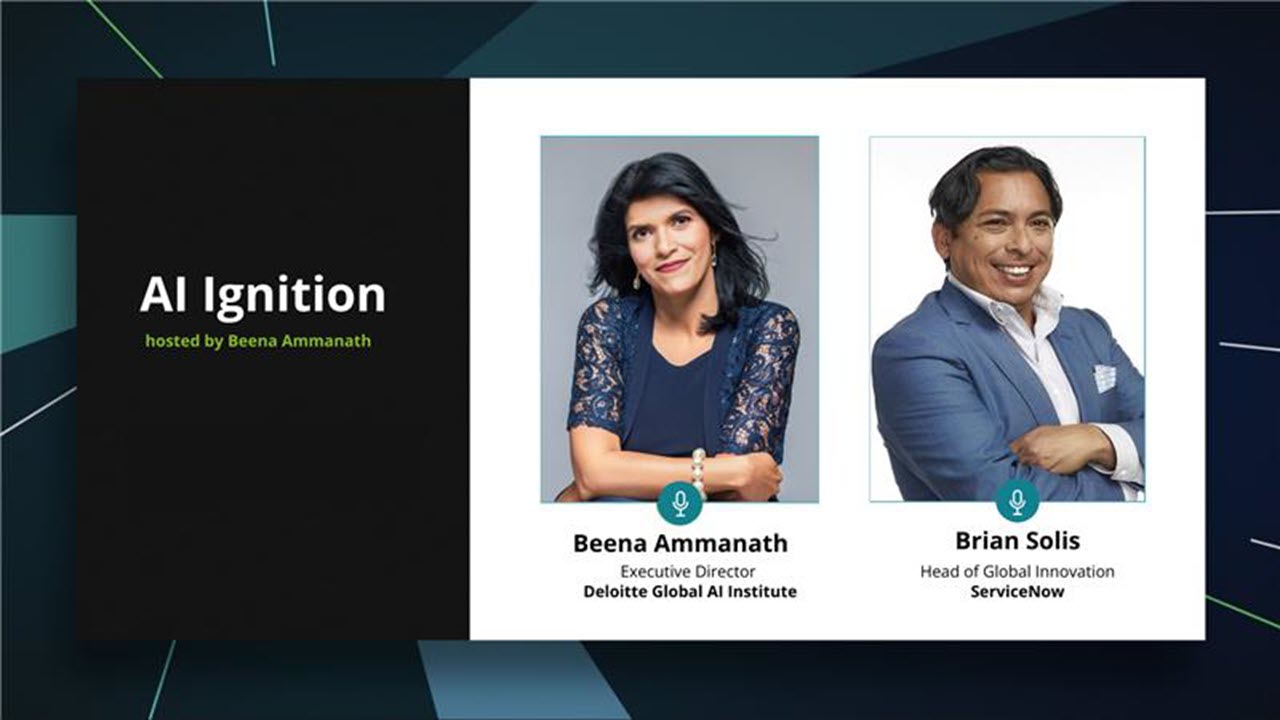
I joined Deloitte’s AI Ignition podcast with beena ammanathCEO, Deloitte Global AI Institute, to talk about why AI feels different from past technology waves, what it demands of leaders, and how we can turn disruption into competitive advantage.
Beena began by reminding us of a simple truth from Deloitte research: “technology advances at its own pace, but technology adoption in an organization advances at the pace of the organization’s culture.” That became the backbone of our conversation.
Please watch/listen here.
Why AI Feels Different (and What to Do About It)
AI triggers something deeper than the usual automation cycle.
After watching “Godfather of AI” Geoffrey Hinton’s sobering exchange with Steve Bartlett in Diary of a CEO about the future of jobs and humanity, I had to pause and think about our next steps. His vision of the future of work was neither, shall we say, cheerful nor terribly motivating. But fear without agency is paralyzing. It is easy to fall into a spiral of dystopia. However, I think it’s best to treat those scenarios as inputs for planning, to reverse engineer those potential scenarios to help people take steps to reshape their future and the future of work, now.
Leaders and employees are still figuring out how to collaborate with AI. Most organizations are testing small automations or pilots, but “very few are reimagining what their future organization could look like…in partnership with artificial intelligence.”
That’s the job. We can shape what comes next.
I accept that there is much to learn and much to unlearn in the future.
The transformation begins with a change of mentality.
Having that change of mentality is giving yourself the gift of learning and unlearning, of seeing what you couldn’t see before, of doing what you couldn’t do before.
We are all tempted to manage the future with the logic of the past. That only produces iteration. AI deserves and requires innovation, the quest to create new value.
Beena underscored the same point from Deloitte’s research: technology advances at its own pace, but adoption advances at the pace of culture and change. If we do not evolve the way we think and work, technology will not be able to deliver on its promise.
Start with a future motivating state
Before roadmaps, start with the vision. I shared how historic entrepreneur and venture capitalist Vinod Khosla’s provocation, “there are only 200 people in the world who understand what is really happening right now,” prompted me to dig deeper.
Your job is to do that 201 within your own company.
Start by defining a motivational future state: an inclusive and inspiring vision of where you want to be in 18 to 24 months with AI and how you’ll know you’re on track along the way. The goal is to make that vision tangible and aspirational, one where people see themselves in it and believe they play a role in making that vision a reality. Then, reverse engineer the steps and measures (OKRs/KPIs) that people can align with and get to work.
This requires a change of mentality:
“To transform your mindset and your organization, you have to start by altering yourself.”
It means unlearning patterns that by default lead to incrementalism. Otherwise, “we limit our opportunities and our results to iteration and not innovation.”
Culture is the catalyst
I have spent years in transformation work. After constantly studying the waves of AI innovation, digital transformation, and now business transformation, I discovered that the biggest catalyst andThe inhibitor that drives change is culture. Beyond the vision and mission statements, behind the earnings calls and advertising, people need to see themselves in the story and as part of it from beginning to end. They have to believe they have agency in the outcome and share a vision, incentives and motivation with leaders and teams across the organization.
“If you can’t articulate what the future is going to look like… then you can’t have a culture that brings that AI transformation to life.”
Measure what matters
Execution turns vision into speed.
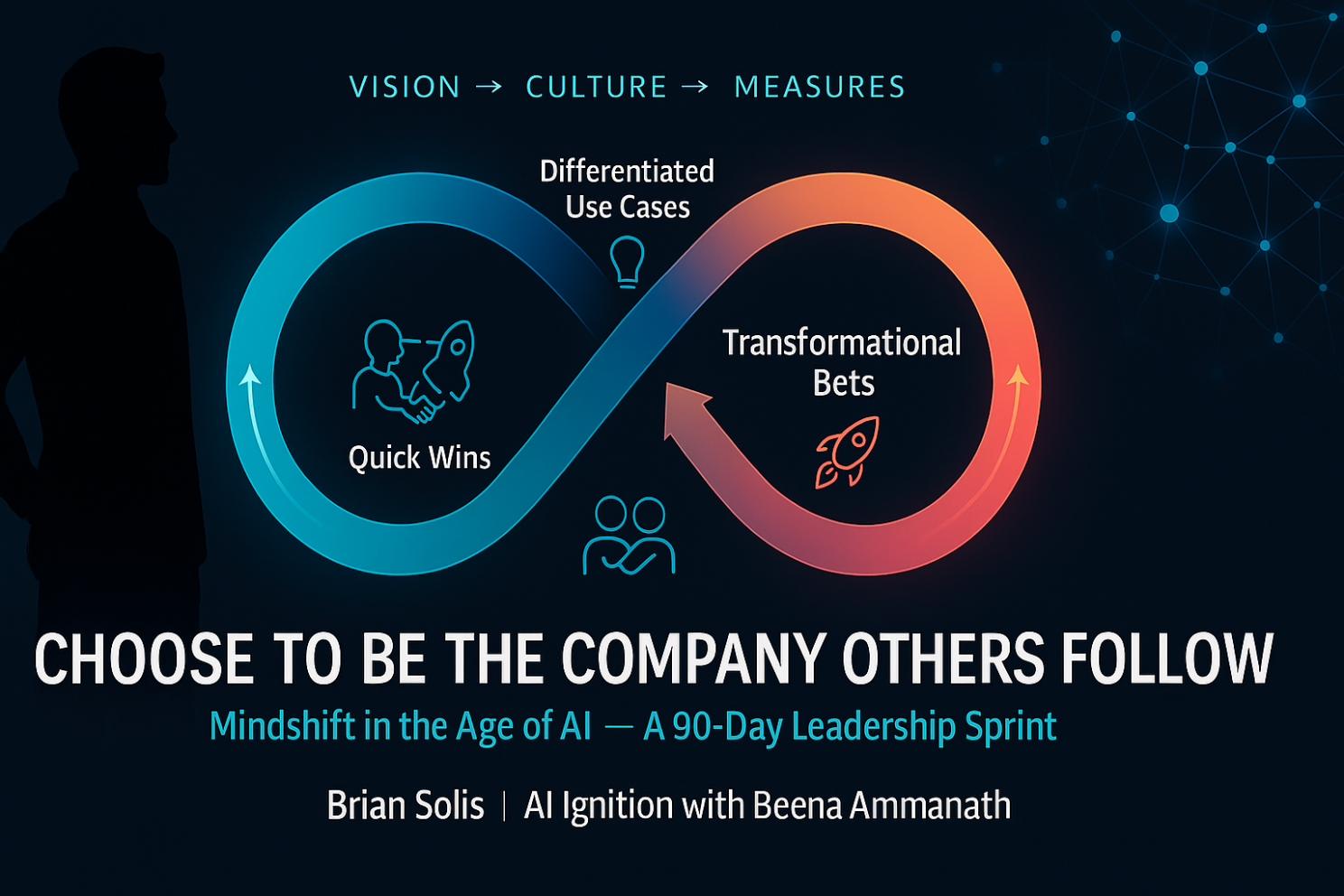
Beena insisted on the execution. My answer: divide the portfolio into three lanes in parallelnot sequentially. This was inspired by Gartner research:
- Quick victories to build confidence and momentum.
- Differentiated use cases that create advantages (not just an “AI-driven status quo”).
- Transformational bets that alter the trajectory.
If you can’t describe the vision and measurements for each lane, you’re not ready to execute.
The workforce: from roles to results
Anxiety persists because people don’t see where they fit. Therefore, we cannot leave the workforce behind.
Leverage the vision and then audit your workforce against its articulated state of future motivation: what capabilities are missing, where do you excel, what can AI agents do today and tomorrow, what requires human orchestration, and how will success be measured?
Don’t tell people to “use AI for deeper work” without defining what deeper work ishow to acquire the skills and how they will be recognized.
“What we can do is start to get some tangibles…then look at the workforce and audit it…what are the jobs we need, what are the skills we need, how are we going to get people there and how are we going to balance them with AI and empower them so they can execute?”
Fear and uncertainty disappear when people know what success looks like and how they will be supported to achieve it.
Align progress with an AI maturity index
We also discuss industry patterns. From our last ServiceNow AI IndexWe saw AI maturity decline nine points year over year. This was a great finding since, on average, companies obtained a score of 35 out of a possible 100 (100 being the most mature). Last year, the average score was 44.
We learned that this year companies expressed that AI was advancing too quickly. In the last three years alone, we’ve experienced the sudden rise of generative AI, then AI agents, and now the agency enterprise. Organizations struggle with the speed of change and the governance needed to pilot and scale safely and effectively.
Still, I’m seeing bold pilots in manufacturing (robotics, computer vision, and physical AI); Beena noted strong acceleration in financial services and life sciences and healthcare, helped by rich data and mature use cases.
The pattern is clear: governance plus vision plus experimentation accelerate maturity.
Dream bigger than optimization
Optimization is something that is at stake.
In the short term, expect a lot of iteration…automation…optimization. And that’s good. It is important to show how to improve what we did yesterday, better, less expensive and more scalable tomorrow. This is how companies adopt technology. Necessary, but not sufficient at the speed and scale we are seeing between AI-Native and AI-First companies.
The real opportunity is that AI offers the opportunity to do what you didn’t do yesterday. I envision org charts where we see AI roles alongside digital employees and teammates. If done right, that produces not only linear growth but also exponential results.
Use AI to rethink customer relationships
A practical example is CRM.
A practical opportunity: the “own” side of customer relationships. Many companies invest in acquisition motions and supporting infrastructure, but treat retention as a line of scrutiny… that is, until customers threaten to leave. But the value is compounded on one’s own side.
“It is less expensive and more strategic to keep a customer happy than to try to acquire a new one.”
AI can change that. We have long treated service and success as cost centers. But no one wakes up expecting to talk to a chatbot or sit in line at a contact center. With AI agents dedicated to customers, we can deliver real results quickly, reduce complexity, and turn service into growth.
AI can turn the service and success of cost centers into growth engines, with dedicated customer agents, integrated journeys, and outcomes that feel as valued as the day they signed.
Closing: Choose to be the company others follow
This is your time to decide whether AI happens in or through your organization. The difference is a leader willing to say, “I don’t know what I don’t know” and then act with conviction to fill in the blanks.
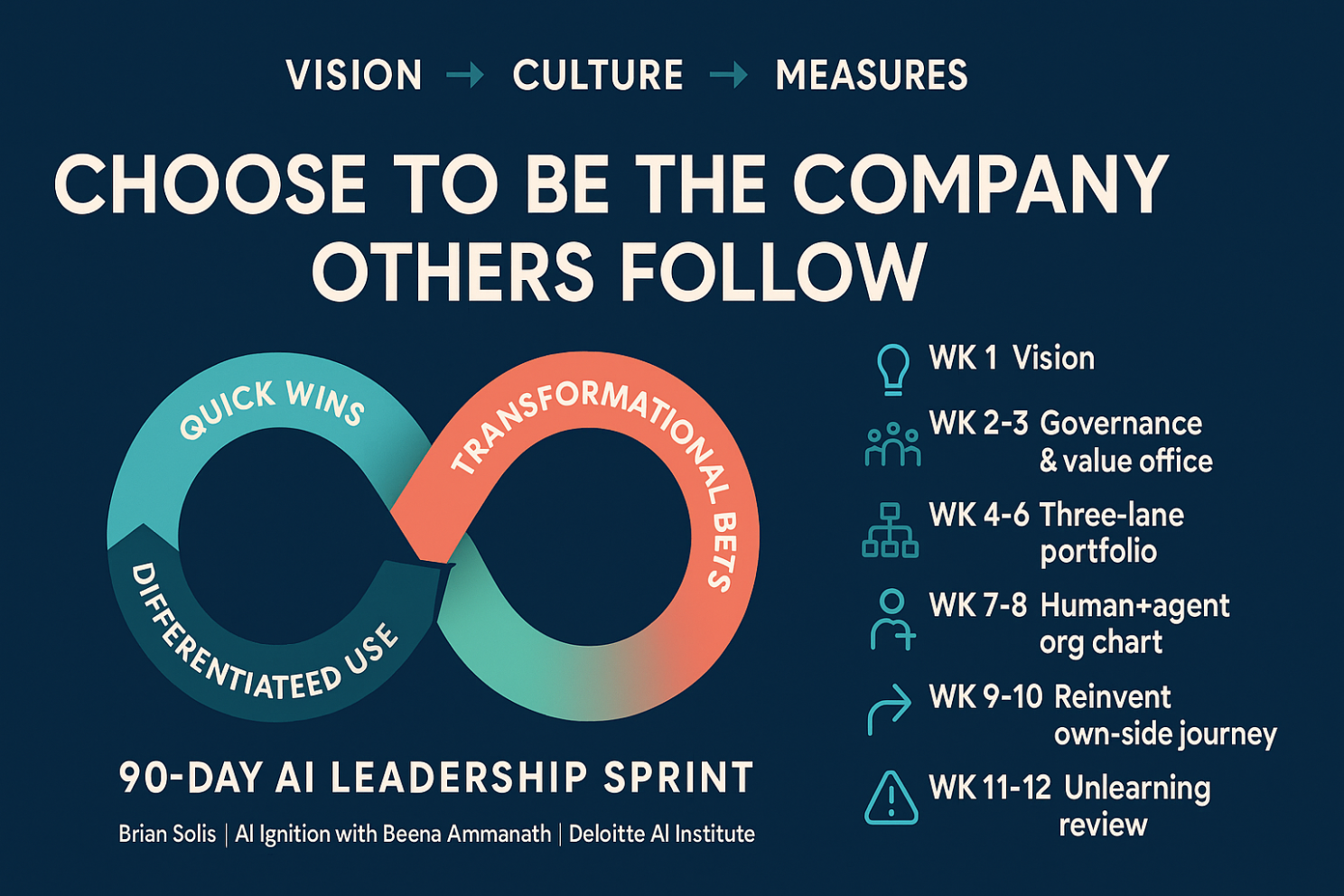
This is my challenge to you, wherever you are in the organization, a 90-day sprint to make the future tangible:
Week 1: Leaders, write your motivational future state on a page. Invite to participate. Name the results that customers and employees will feel in 12 to 18 months. Share it with your leadership team.
Week 2-3: Establish an AI Value and Governance Office that combines risk with product, operations and finance. Establish non-negotiable metrics for adoption, experience, speed, and revenue impact.
Week 4 to 6: Launch your three-lane portfolio: 3 quick wins (confidence and capability), 2 differentiated use cases (what your peers aren’t doing), and 1 transformational bet (what changes your trajectory).
Week 7-8: Audit roles and skills against the vision. Publish a conscious human + agent org chart that empowers and grows your workforce, not automate them. Fund learning paths linked to recognition and rewards. Document your potential for exponential production that would not otherwise be possible. This is your future pit.
Week 9-10: Reinvent the “own” side of your business with CRM, moving from a cost center mentality to an infinite growth center. Choose a critical customer journey and deploy agents to deliver personalized end-to-end experiences and results that customers would choose again.
Week 11-12: Conduct an unlearning review. Remove a legacy KPI, a legacy process, and a legacy belief that no longer serves the vision. Celebrate what went from iteration to innovation.
Put dates on a calendar. Owners of the name. Assign budget. Report progress to your board of directors monthly. You will find that once the vision is explicit and measured, momentum increases. Put words to it, articulate the learnings and a motivating state for the future, and the culture continues.
Obviously this is fast, too fast for most to accept voluntarily. So what? We don’t need to wait for perfect deadlines or clarity to lead. We need the courage to begin, the discipline to measure, and the humility to learn and unlearn along the way… especially in the face of the unknown. Yo
Define what happens next.
If you take this 90 day challenge, tell me what you learned and what you built, or at least, did differently. Let’s make this the year we choose transformation over hesitancy and formulaic automation, to become the companies others follow.
Adapt or die!
change of mentality | Speech | Fact sheet
#Driving #Transformation #FutureProof #Business #Age