




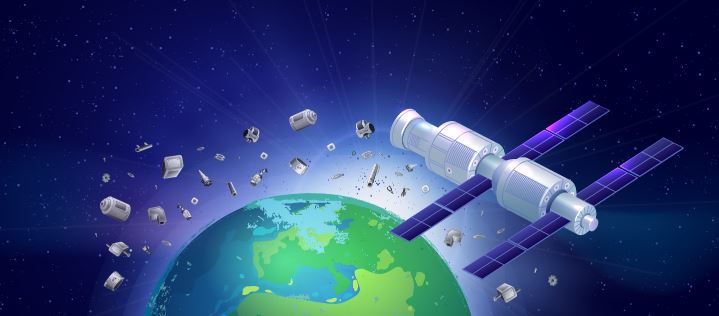
The researchers used climate scenarios to estimate the future number of satellites that could safely fit into low Earth orbit.
Introduction What do you think of when you hear the term “climate change”? You probably think about global warming and greenhouse gases. But I bet you didn’t think about satellites in space! Satellites help us with things like communication, weather forecasting, and navigation. Many satellites, as well as the International Space Station, orbit in the thermosphere and exosphere. These are the upper layers of our atmosphere. Collectively, this region is called low Earth orbit. And these parts of the atmosphere are affected by climate change. ****Explanatory box**** Greenhouse gases are increasing everywhere in the atmosphere due to climate change. Greenhouse gas molecules absorb thermal energy from the sun. They also give off heat energy. Near Earth, this heat is trapped by other molecules. In the upper atmosphere, where there are far fewer molecules, heat is lost to space. This means that the upper atmosphere is cooling due to climate change. ****** Scientists know that climate change is cooling the thermosphere. This changes the density of the air and causes the thermosphere to contract. When the thermosphere becomes thinner, a satellite in orbit will remain at the same altitude, but the air it moves through will be less dense. However, there is still enough air for a satellite to interact and create drag. This will cause the satellite to lose power and eventually fall to Earth (which is sometimes a good thing). If the air is less dense, the resistance will also be less. Satellites could stay in orbit longer. And this could become a problem in the future. Currently, the recommendation is that satellites deorbit within 5 years after completing their missions. Satellites can actively or passively lose energy and fall to Earth. But we continue to add more and more satellites to low Earth orbit. Unfortunately, there is also a large amount of space debris in this region (see Figure 1 on page 2). It comes from satellites that collided with each other in the past (and did not fall to Earth). Enough collisions could start a chain reaction and create much more debris. Scientists call this possibility Kessler syndrome. If it happened, it would be difficult to put more satellites into low Earth orbit. We wanted to know how many satellites could be in orbit without triggering Kessler syndrome. This number represents the carrying capacity of low Earth orbit. We also wanted to know how future climate change will affect this figure. Methods We modeled changes in the density of the thermosphere until 2100. We used models from the National Center for Atmospheric Research and the US Naval Research Laboratory. We did this for three different climate scenarios. These were from the International Panel on Climate Change (IPCC). We then use this information to help develop our own model. We calculate the carrying capacity of satellites in low Earth orbit. We call this value instantaneous Kessler capacity. We calculated this for our three climate scenarios up to 2100. We then compared them to a baseline estimate of greenhouse gas values in the year 2000. Results We found that the density of the thermosphere decreased: at higher altitudes. during solar minima. There is a natural 11-year cycle of solar activity that impacts the thermosphere. in more severe climate change scenarios. We found that Kessler’s baseline instantaneous capacity was 34 to 72 million satellites (see Figure 2 on page 3). Kessler’s instantaneous capacity was lower during solar minima. It was also lower during more severe weather scenarios. By 2100 we could see an overall 50-66% reduction in capacity between 200-400km. Between 400 and 1,000 km, this overall reduction increases to 60-82%. Most (98–99%) of this capability is available at lower altitudes. Discussion Our research shows that we need to think about our sustainable use of low Earth orbit. Climate change will decrease the density of the thermosphere over time. This reduces drag on the satellites and will allow them to stay in orbit longer. And the longer they stay in orbit, the greater the chance of a chain reaction of collisions. In the future it will be more dangerous to put new satellites into low Earth orbit. Our data shows that we have room in low Earth orbit for millions of satellites. But there are some things to consider. Climate change will reduce the number of satellites we can place in low Earth orbit. The vast majority of satellite capacity will be at lower altitudes. Space debris falls rapidly to Earth from this region due to drag. In our model, this means that many collisions can occur and not trigger Kessler syndrome. But satellites are expensive and have a useful life of decades. Not many people would want to place satellites at these altitudes if the chance of collision was high. Solar activity naturally changes the carrying capacity of low Earth orbit. At solar minima, low Earth orbit cannot safely accommodate as many satellites. Any sustainability plan must consider the 11-year solar cycle. There are many things we can actively do to increase the payload capacity of low Earth orbit. We can demand that new satellites have collision avoidance technology. We can also implement space debris removal projects. Many governments track satellites and space debris. Better monitoring and coordination between governments could reduce collisions. Conclusion Climate change has the potential to affect many things in our world. And satellites in low Earth orbit are really far from our daily lives. But imagine if all those satellites collided with each other. You won’t be able to get directions on your phone or watch your favorite TV show. And it would get worse. Planes could not fly safely. We couldn’t predict the weather. And international communication would be limited. So what can you do? The most important thing you can do is limit your greenhouse gas production. This means reducing the amount of energy you use and the number of things you buy (which takes resources to produce!). For example, avoid buying unnecessary items or try to get second-hand things. Also use public transportation, ride a bike, or carpool whenever you can. You can also write to your representatives about investing in green energy solutions and regulating local impacts on climate change. Every voice counts!
#climate #change #affect #satellites