




At first glance, a forest is a peaceful place and the trees are the calmest. However, researchers like Dr. Richard Karban, a formally trained ecologist and member of the UC Davis Department of Entomology since 1981, are changing the narrative. Turns out the forest is pretty loud, we just can’t hear them.
The media often calls Dr. Karban the “Plant Whisperer”, a title I was unaware of until we spoke. He humbly avoids the label and notes that he is just one of a growing number of experts dedicated to the field of plant communication.
Covering a variety of intriguing topics, from “eavesdropping” plants to distinct “personalities” of plants, Karban is fully aware of the controversy surrounding his field. But he emphasizes that communication between plants is not a fantasy; It is a biological response to specific signals.
These signals generally occur in three areas: through the air, beneath the soil, and within the plant tissues themselves. Karban’s research begins with the first area: the invisible signals that float on the breeze.
Chemical warfare and air signals

Advanced plant behavior is now at the center of one of the most heated debates in ecology. Decades ago, little was known about it. Today, researchers and scientists alike have become more receptive to the idea that trees and plants are not passive organisms. In fact, many researchers, like Dr. Karban, argue that forests are highly communicative biological networks.
These are sophisticated behaviors, but Karban attributes them to evolution and natural selection, not hidden sentience. He warns against projecting human emotions onto biology, but suggests that to understand plants, we must understand their version of a “Hierarchy of Needs.” Plants’ top priorities are simple but non-negotiable: light, water, nutrients, and not being eaten by insects.
Dr. Karban didn’t expect plants to take center stage in his career. Initially it was proposed to understand animals in crowded conditions. While studying cicadas early in his career, a colleague mentioned that the trees the insects fed on kept responding.
This piqued his curiosity. He learned that when threatened, plants release specific chemicals They act as warning signs for their neighbors.
“At first I was interested in induced responses,” says Karban. He began studying interactions between plant species, specifically sagebrush, wild tobacco, and tomato plants.

His work focuses on volatile organic compounds (VOCs). These are airborne chemicals that trees release when they are stressed or attacked by pests. “Plants do not have ears, but they perfectly perceive the chemical signals transmitted by the air,” he explains.
His experiments with sagebrush in California revealed something remarkable: Plants exposed to VOC “conversations.” of their damaged neighbors suffered up to 40% less insect damage than unexposed control plants. Basically, they heard the warning cry and raised their shields.
The great network of wood
While Karban looks into the air, other researchers look underground. Dr. Karban’s work aligns with a massive shift in ecology over the past three decades. Researchers like Dr. Suzanne Simard of the University of British Columbia argue that forests are not collections of solitary organisms, but rather connected systems.

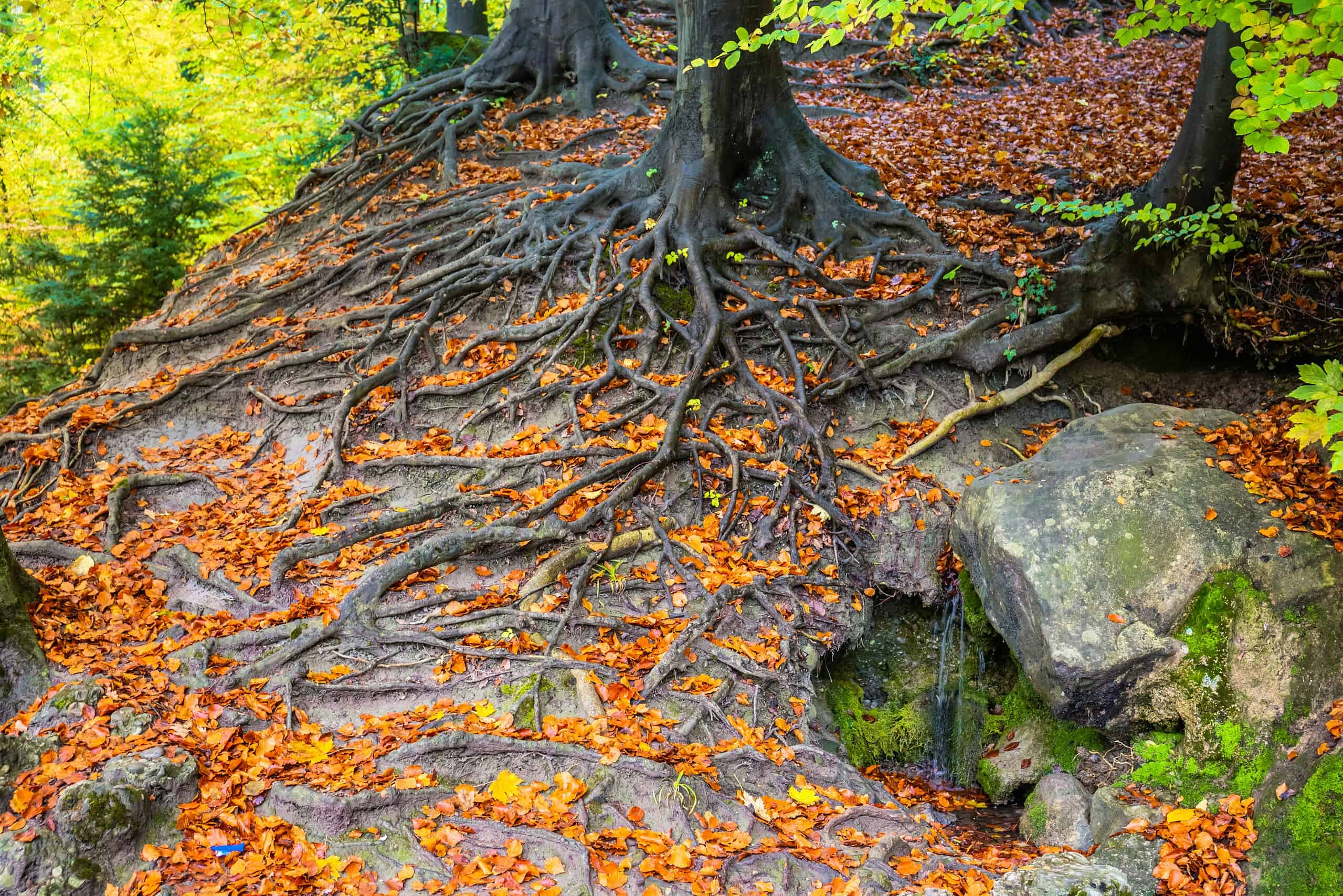
Simard’s research popularized the term “Wood-Wide Web”.” He discovered that trees are connected through mycorrhizal networks: vast networks of underground fungi that link tree roots. These networks act as a transit system for water, nitrogen, phosphorus and signaling molecules. For decades, these sophisticated survival strategies were invisible to the human eye. Today, however, we can use technologies such as carbon isotope tracking, microelectrode sensors, and advanced root imaging. Armed with this technology, ecologists have discovered compelling evidence that trees constantly exchange chemical warnings, fire off electrical impulses, and even transport carbon through underground fungal highways.
The role of fungi in this mechanism should not be underestimated. Since fungi cannot photosynthesize, they rely on trees for sugar (carbon). In return, the fungi act as a vast underground mining operation, scouring the soil for water, phosphorus and nitrogen that tree roots cannot reach on their own. It is through these fungal filaments that physically link the root systems that the forest becomes a communicative network.
Their research suggests that up to 40% of the carbon produced by a mature tree later it may appear on nearby seedlingswhich implies an intentional redistribution of nutrients. This has given rise to terms such as “mother trees,” which suggest that older trees help younger relatives survive.

Skeptics say
The issue of the Wood Wide Web, however, is far from resolved. In fact, it is bitterly debated.
Dr. Kathryn Flinn, an ecologist at Baldwin Wallace University, believes that while mycorrhizal networks move resources, this does not mean that the tree sending those resources is making a strategic or selfless decision. She explains that ecology is often more mechanical than metaphorical. A 2023 review in Trends in plant science He noted that while network transfers exist, interpreting them as intentional cooperation remains “scientifically unstable.”
One of the most polarizing findings in this field has been the discovery that plants send electrical impulses through tissues when they are injured or stressed. These pulses activate defense genes and travel much faster than chemical signals.
Meanwhile, Dr. František Baluška from the University of Bonn explains in the book: Signaling and long-distance systemic communication in plantsThat electrical signaling allows plants to coordinate responses throughout their bodies in seconds. It is not a nervous system in the animal sense, but, in Dr. Baluška’s opinion, it is certainly a form of communication.
Critics remain cautious in how these findings are communicated to the public. They argue that comparing these signals to neurons risks misleading the public. They believe there is a need to better clarify what is considered a “signal” and what is considered “information.”
Another notion that is gaining attention is that of a ‘mother tree’ recognize family members. Some scientists believe that trees can recognize members of a family and redistribute nutrients accordingly. This statement is currently highly debated. However, scientific evidence suggests that there is more to this theory than mere fantasy. Studies on Douglas fir and beech trees show that related individuals compete less for root space and channel more carbon to genetically similar neighbors.
A change of perspective

Regardless of disagreements over interpretation, there is a growing consensus that communication, whatever its mechanism, occurs between trees and that this appears to improve the resilience of forests.
Trees connected through fungal networks they show higher drought survival rates, recover faster after fire, and store more carbon per acre than fragmented forests. As climate change accelerates heat waves, floods and pest outbreaks, understanding how forests redistribute resources could influence global conservation policies. Scientists agree on the mechanism, but debate the intent of these signals.
Karban believes that we should not be afraid of these arguments and that skepticism is a healthy part of science. It is by asking questions that answers can be refined and become reliable and evidence-based.
“I’ve had mixed reactions to my studies,” he says. “I explain to skeptics that science is only credible if the experiment is repeatable by another person, with reliable and measurable results.”
“There are many radical claims about plants that are not necessarily supported scientifically through experiments that are not always repeatable, for example that plants grow with music.”
“You can accept an idea that stands up to scrutiny,” he says.
He says his career has not been marked by ‘eureka moments’. Rather, it has involved a slow, incremental acquisition of knowledge and understanding about plant species and their responses to the environment and to each other. But it still has many challenging ideas. For example, he is now interested in studying the “dialects” used by sagebrush plants, as well as the plants’ different “personalities,” as he calls them.
Over time, technology should help researchers catch up on these questions. With the rise of nanotech sensors, AI-assisted ecosystem models, and MRI-like root imaging, our instruments are finally becoming sensitive enough to listen to the forest. As the data becomes clearer, the argument can move from “Do trees talk?” to “How complex is your conversation?”
For now, we can enjoy the mystery and wonder of the forests, leaving a lot to science and a little to the imagination.
#study #forests #plants #cooperating #talking