



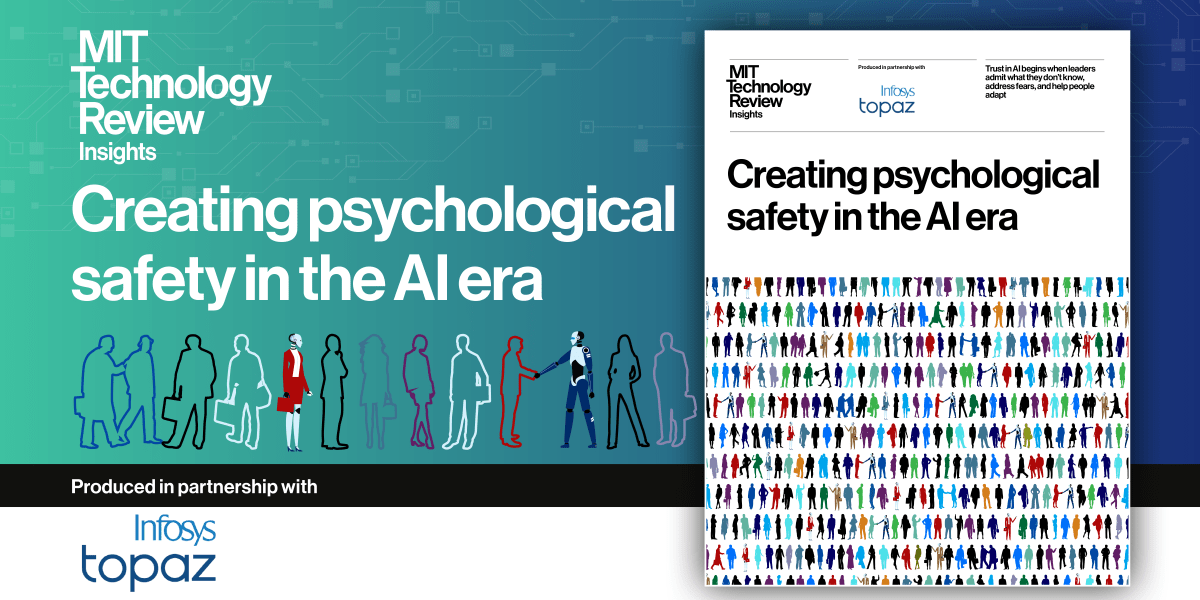
“Psychological safety is mandatory in this new era of AI,” said Rafee Tarafdar, executive vice president and chief technology officer, Infosys. “The technology itself is evolving very quickly: companies have to experiment and some things will fail. There needs to be a safety net.”
To assess how psychological safety influences AI success at the enterprise level, MIT Technology Review Insights conducted a survey of 500 business leaders. The findings reveal high levels of self-reported psychological safety, but also suggest that fear still has a foothold. Anecdotally, industry experts highlight one reason for the disconnect between rhetoric and reality: While organizations may publicly promote a message that is safe to experiment with, deeper cultural undercurrents may counteract that intent.
Creating psychological safety requires a coordinated, systems-level approach, and human resources (HR) alone cannot achieve that transformation. Instead, companies must deeply integrate psychological safety into their collaboration processes.

Key findings of this report include:
- Companies with experiment-friendly cultures have greater success with AI projects. The majority of executives surveyed (83%) believe that a company culture that prioritizes psychological safety significantly improves the success of AI initiatives. Four in five leaders agree that organizations that foster safety are more successful in adopting AI, and 84% have seen connections between psychological safety and tangible AI outcomes.
- Psychological barriers are proving to be greater obstacles to enterprise AI adoption than technological challenges. Encouragingly, almost three-quarters (73%) of respondents indicated that they feel safe giving honest feedback and expressing opinions freely in their workplace. Still, a significant proportion (22%) admit that they have hesitated to lead an AI project because they could be blamed if it fails.
- Achieving psychological safety is a moving target for many organizations. Less than half of leaders (39%) rate their organization’s current level of psychological safety as “very high.” Another 48% report a “moderate” degree. This may mean that some companies are pursuing AI adoption on cultural foundations that are not yet completely stable.
This content was produced by Insights, the custom content arm of MIT Technology Review. It was not written by the editorial staff of MIT Technology Review. It was researched, designed and written by human writers, editors, analysts and illustrators. This includes writing surveys and collecting data for surveys. The AI tools that could have been used were limited to secondary production processes that underwent extensive human review.
#Creating #psychological #safety #age