


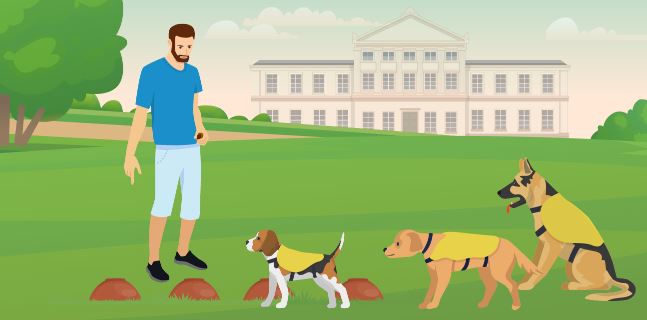
The researchers compared the olfactory abilities of dogs of different breeds to see which types of dogs might be the best searchers.
Introduction Humans own dogs for a wide variety of reasons. Many people choose a certain breed of dog because they are cute, friendly, or energetic. But in the past, we needed dogs to help us with tasks like hunting, herding sheep, or protecting us from predators. To do this, humans chose dogs for a certain trait. The selected dogs bred and had puppies, many of which had the desired trait. Humans, on the other hand, chose the pups best suited for the particular task. Over time, that trait became more pronounced and more common. We call this artificial selection. Dog breeds emerged from artificial selection for different traits. For example, German Shepherds were bred to herd sheep. In contrast, beagles were bred to hunt small game animals. In our study, we wanted to know if dogs bred for olfaction (their sense of smell) are still talented sniffers today. We also wanted to know if a dog’s personality affected its ability to smell good. Some of the dogs in our study had various levels of prior training, but others had none. This allowed us to focus on dogs’ natural ability to smell food. Methods We used the Natural Detection Task to find out if some dogs naturally have a better sense of smell than others. This is a simple activity in which dogs have to find a certain amount of food in a natural search situation. It takes place in a field or in an empty room. Before the test, we placed four pots in a row (see Fig. 1 on page 2). One of the pots hid a container of food. Once the test began, the dog needed to identify the container with the food within one minute. The test had three levels. Each dog needed to pass one level before moving on to the next. On the first level, the food containers were open under the pots. On the second level, the containers had lids with holes in them. On the third level, the food containers were completely sealed. The test ended if the dog did not choose the correct pot three times in a row. We used three factors to measure how well a dog did on the Natural Detection Task: Whether the dog passed the third level. How many levels the dog passed and how many tries it took. How quickly the dog made successful decisions. We compared breed groups (groups of dogs selected for their sense of smell, cooperation, or both). We also compare races. Finally, we examined traits such as responsiveness, activity, attention-deficit/hyperactivity disorder, and prior training. We wanted to see if these had an impact on your success. Results We were able to compare dogs within the same breed and between different breed groups. Breed groups → none of the breed groups scored significantly better than the other (Fig. 2). Each breed group had the best and worst performing breeds. Races → some races were more successful. But other races were faster in completing the levels. For example, border collies were especially good at reaching the highest level on the task. But the beagles were the fastest to successfully complete the last level. Personality and training → dogs that responded better to training performed better overall. Other traits (such as excitability and attention-deficit/hyperactivity disorder) did not affect success. Dogs with more advanced training were slower at the last level. Discussion Our results show that breed groups do not really tell us whether a dog will have a good sense of smell or not. Dogs that were bred to sniff, work with people, or both had similar task results. This could be because people used to breed dogs for these skills, but this has decreased in recent years. This is called relaxed selection. Nowadays, people often breed dogs based on their looks or how well they get along with people. We also saw many differences between dogs of the same breed. This shows that each dog’s genes and individual life experiences are very important. The natural detection task is a useful tool for comparing how well different dogs can smell. Unlike many previous studies, the task is based on the natural attractiveness of the food, so untrained dogs can be tested. This can provide early information about how well a dog might perform if trained as a search dog. After all, dogs naturally don’t want to find things like explosives or drugs. These smells mean nothing to them, so they need training to identify them and then alert the caregiver. The Natural Detection Task allows us to evaluate a dog’s natural and untrained olfactory ability. Conclusion Modern research shows that some old ideas about animals’ abilities or traits may not be true. We’re always learning new things about how animals think, learn, and solve problems! You can explore these ideas by asking questions and observing the animals around you. You can also use this thought in your own life. Do people make assumptions about others based on how they look, where they are from, or what group they belong to? Instead of accepting those ideas, first ask yourself, “Is that really fair or true?”
#dog #breeds #sense #smell